
If you’re shopping for a truck camper, there’s a good chance you’re comparing hard side campers with pop-up (also called pop top) models. Neither design is objectively better. They’re built for different priorities, and both have loyal owners who will swear they made the right choice. Unfortunately, finding reliable information online isn’t always easy. Manufacturers naturally emphasize the strengths of their own products, while forum discussions are often filled with opinions presented as facts. If you’ve reached this stage of your research, you’re probably trying to separate the myths from the reality. This guide breaks down the real differences between hard side and pop-up truck campers so you can choose the style that actually fits the way you travel.
What’s the Difference Between a Hard Side and Pop-Up Truck Camper?
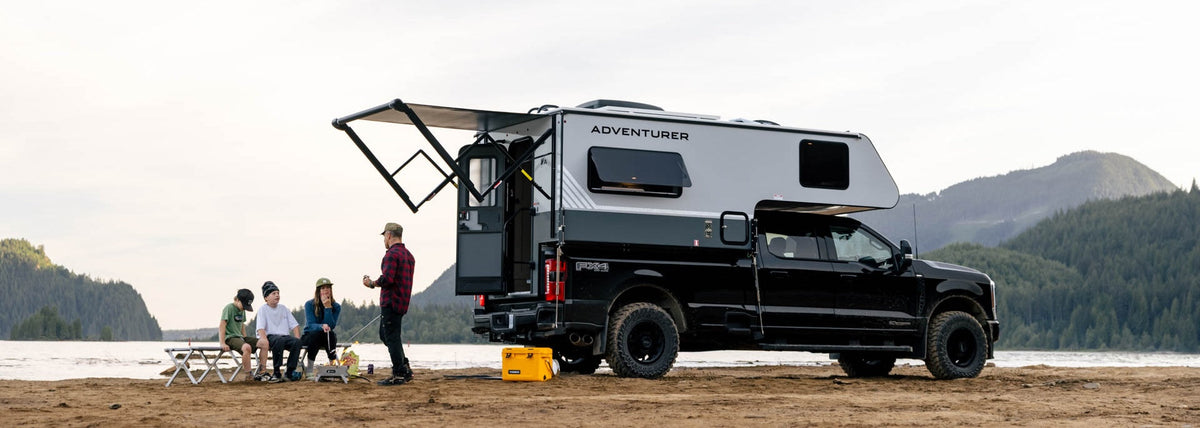
While both camper types will give you the level of freedom and mobility to adventure and explore at will, they’re distinct in their design, features, and capabilities. Hard side campers feature permanent insulated walls that remain in place whether you’re driving or camping. Because the structure is fixed, they often provide additional overhead storage, require no setup when you arrive at camp, and generally offer better insulation and security.
Pop-up truck campers lower their roof while traveling and raise it once you’re parked. Many use fabric walls, while others use rigid telescoping wall systems, so “pop-up” doesn’t always mean fabric-sided. Although many buyers assume pop-ups are significantly lighter than hard side campers, comparable models are often much closer in weight than expected. Their biggest advantages come from their lower travel height and center of gravity rather than dramatic weight savings.

Hard Side Truck Camper Pros
Hard side truck campers are typically better insulated, quieter in windy conditions, and offer more overhead storage than comparable pop-up models. Permanent walls provide better thermal performance in both hot and cold weather, making them a popular choice for four-season camping and extended trips.
Another major advantage is convenience. There’s no roof to raise or lower each time you stop, making it easy to pull over for lunch, take a break during a long drive, or spend several weeks living out of your camper without the extra setup becoming part of your daily routine.
Hard side campers also provide greater security. Unlike fabric walls, rigid walls can’t be cut, which can provide additional peace of mind when parking in urban areas, traveling full-time, or camping in places where security is a higher priority.

Hard Side Truck Camper Cons
The biggest trade-off with a hard-side truck camper is its higher travel height. A higher profile creates more wind resistance on the highway, can make the truck more susceptible to strong crosswinds, and limits access to some low-clearance roads, parking garages, and home garages.
The additional height also raises the camper’s center of gravity, which can be more noticeable on uneven terrain or winding backroads. While this isn’t a problem for most camping situations, it’s something to consider if your travels regularly take you down rough forest roads or narrow off-road trails.
Pop-up Truck Camper Pros
The primary advantage of a pop-up truck camper is its lower travel profile. With the roof collapsed, pop-ups are more aerodynamic, can slightly improve fuel economy, and are noticeably less affected by strong crosswinds because there’s less surface area for the wind to push against. Their lower center of gravity also creates a more stable driving experience on rough roads, washboard surfaces, and uneven terrain. Combined with their shorter overall height, pop-ups are often better suited for drivers who regularly travel off-pavement or explore narrow back roads with low-hanging branches.
The lower profile also makes day-to-day ownership easier. Pop-up campers are more likely to fit in residential garages, clear parking structures, and comply with height restrictions in some neighborhoods and municipalities. For many owners, that everyday usability is just as valuable as the camper’s off-road capability. Once deployed, many pop-up campers offer standing headroom comparable to a hard side, and many models are available with features like wet baths, indoor showers, solar systems, and full kitchens.

Pop-up Truck Camper Cons
The primary tradeoff with a pop-up truck camper is reduced insulation. While a well-built pop-up with a quality heater can remain comfortable even well below freezing, fabric walls simply don’t retain heat as effectively as insulated hard walls do when the heat source is turned off.
You’ll also need to raise the roof each time you arrive at camp and lower it before getting back on the road. While the process is generally quick, it can become less appealing if you’re making frequent stops or living in your camper for extended periods.
Fabric walls are also inherently less secure than rigid walls since they can be cut. Although this isn’t a concern for every traveler, it’s worth considering if you frequently park in urban areas or spend long periods away from your camper.
Build Quality Matters More Than Many Buyers Realize
One of the biggest misconceptions about pop-up campers is that common complaints like water leaks, excessive fabric flapping, or the inability to carry rooftop gear are simply part of owning a pop-up. In reality, many of these issues come down to build quality rather than the pop-up design itself. A well-built pop-up can support rooftop accessories and even rooftop air conditioning when the roof and lift system are designed for the additional weight. Roof construction quality drives long-term water tightness and durability. A well-built roof stands up to hail, falling branches, and years of weather exposure, while a flimsy one is where leaks and damage start. Poorly designed or tensioned fabric walls will flap in the breeze, whereas properly tensioned fabric walls significantly reduce movement and noise in windy conditions.
When comparing campers, especially when shopping for used campers, don’t just focus on whether it’s a hard side or a pop-up. Pay attention to how it’s built. Examine the roof construction, lift mechanism, seals, and overall fit and finish. Those details often tell you much more about how the camper will perform over the long term than the roof design alone.

Long-Term Ownership Considerations
Every truck camper requires maintenance, but the maintenance looks a little different depending on the design. Hard side campers still require regular inspection of roof seams, windows, and exterior sealants. Pop-up campers add another maintenance item to the list: fabric walls. Over time, the fabric, zippers, and seams require occasional cleaning, inspection, and, eventually, replacement. It’s simply another factor to consider when evaluating the long-term cost of ownership.
Neither design is objectively better, and there isn’t one right answer. The right choice depends on where you travel, how you camp, and what matters most once you’re on the road.
Whether you’re ready to pull the trigger on your next camper or you’re comparing models, our team at Truck Camper Garage is here to help. Shop our extensive selection of truck campers online, or stop by in person to browse our showroom.